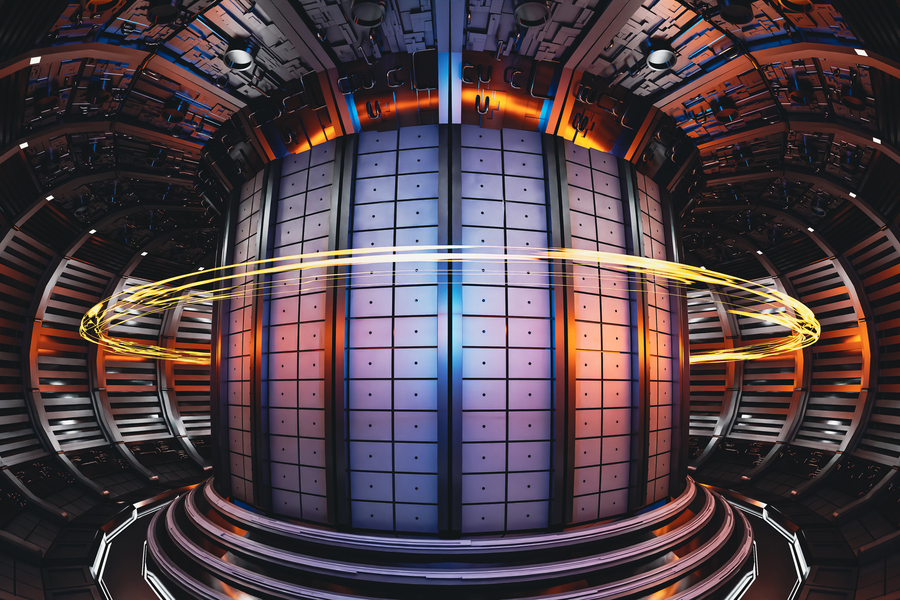
MIT researchers have developed a hybrid modeling approach—combining physics-based simulations with machine learning—to better predict how a tokamak’s plasma behaves during shutdowns (aka “rampdowns”). The goal: avoid damaging disruptions and make fusion reactors more reliable.
What’s the problem?
- Tokamaks are donut-shaped fusion devices that confine ultra-hot plasma using strong magnetic fields.
- When plasma becomes unstable, operators must ramp down the current. But that process itself can trigger further instabilities that damage reactor walls.
- As fusion machines scale up, safely managing these transitions becomes more critical.
The new method
- The MIT team built a model that fuses (pun intended) neural networks with physics-based plasma dynamics simulations.
- Rather than relying purely on large data sets (which are costly and hard to get), their approach uses a relatively small number of tokamak experiments to train the model.
- They used data from Switzerland’s TCV tokamak (Swiss Plasma Center / EPFL) for training and validation.
- Their algorithm can translate predictions into “trajectories” or control instructions (e.g. adjusting magnets or temperature) to guide the plasma safely and swiftly down.
Key findings & implications
- The model achieved high accuracy even with limited data, which is promising since experimental runs are expensive.
- In tests, the control trajectories produced by this method managed rampdowns more smoothly and with fewer disruptions compared to standard approaches.
- The technique could make future fusion reactors more robust, reducing downtime and costly repairs.
- The research supports efforts by MIT spinout Commonwealth Fusion Systems (CFS), which aims to build a compact, net-energy tokamak called SPARC. The model could be incorporated to enhance safety and reliability.